From account creation to first batch validated.
A practical walkthrough covering the two most common use cases — protecting data you hand to a partner, and verifying that buyers you sell leads to are handling them honestly.
Two use cases, one tool
Data licensing & list protection
You license your customer data to a texting partner, SMS provider, or any third party under a list-use agreement. The agreement says: only your offers, no reselling, no calls. Once the data leaves your hands, there has been no way to confirm the partner is actually honoring that.
Seed the list before it goes out. The partner processes the whole batch — seeds included — with no way to tell them apart from real contacts. Assumed captures every SMS, call, and email each seed receives. You compare what came in against the agreement.
Lead buyer verification
You sell leads to buyers downstream — lenders, contractors, service providers. The buyer is supposed to follow up within a certain window, hit a certain cadence, and report outcomes honestly. Most teams verify this manually, by gut check.
Seed a lead before you sell it. Watch what Assumed's inbox shows actually happened to it — first touch time, number of attempts, channels used — and compare that against what the buyer reported back. The same timestamped record that catches bad actors also confirms the honest ones.
Step-by-step guide
Applies to both use cases — the mechanics are the same whether you're seeding a list going out to a texting partner or a lead going to a buyer.
Create your account
Sign up at app.assumed.com — no paperwork, no contract. The free account includes a sample seed so you can see what the inbox looks like before you buy anything.
Create account →Start small — buy 2–5 individual seeds
Don't jump straight to a bundle. Order 2–5 individual full seeds to start. The first run validates the mechanics and your own review process. Scale to a bundle once you know how your partner behaves.
Full seeds ($9/ea) give you email + SMS + voice monitoring. Email-only seeds ($1/ea) work if the partner relationship is email-only.
Label each seed by partner and date
When you add seeds in Assumed, give each one a label that traces back to a specific batch — for example, "SMS-Partner-A-Nov2026". A good label means one glance at the inbox tells you which partner you’re looking at.
Insert seeds into your outbound list
Drop the seeds into your list exactly like real records — same fields (name, email, phone, state). The partner has no way to distinguish a seed from a real contact. The Chrome extension auto-plants a seed into any web form; for file-based lists, paste the contact fields directly.
Get the Chrome extension →Log when you planted each seed
The Chrome extension auto-timestamps contacts planted into a web form. For direct list or file inserts, note the plant time yourself — you’ll need it later to judge how fast the partner acted and whether the cadence matches your agreement.
Review the seed inbox
Check each seed’s inbox over the following days. For each message, look at four things: sender identity, message content (is it your partner’s offer only?), any links (do they resolve to your partner’s sites?), and channel (SMS only? Any calls or emails that weren’t in the agreement?).
Decide, then scale — or escalate
If the batch checks out: scale toward ~1% of your list size for ongoing runs, and retire the seeds from this batch before buying the next round. A 25-contact bundle covers a list of up to 2,500 records at that ratio.
If something’s off — off-contract offers, resale signals, channels that weren’t agreed — you now have timestamped, third-party evidence to bring back to the partner.
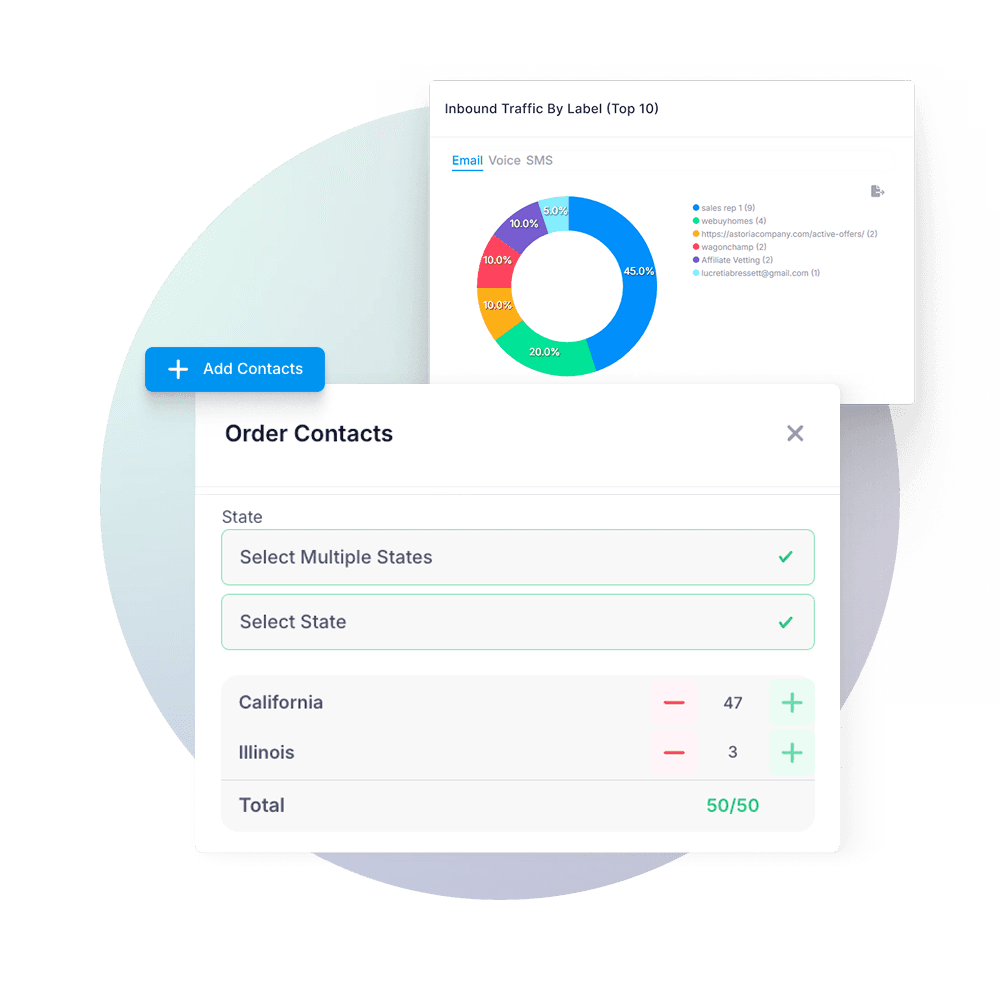
Pick your states, set a quantity.
The order panel lets you allocate seeds by state so they match the geography of your partner feed. For a first run, 2–5 full seeds is enough to validate the mechanics. Scale to a bundle once you've seen a full cycle.
Key mechanics
What a seed is
A working email address and phone number (SMS + voicemail; voice calls also work) with a randomized name and postal address. You can target a specific state or let location randomize. To the partner, it looks identical to a real contact.
Don’t reuse seeds across batches
Once a seed has been exposed to one partner, its contact history makes it unreliable for evaluating a different one. Retire seeds you’re done with and buy a fresh batch for the next run. This keeps each seed’s signal clean.
Seed ratio
Industry standard is roughly 1% of batch size. For a first run, 2–5 seeds is enough to validate mechanics and establish a review process before scaling. A 25-seed bundle covers a 2,500-record batch at that ratio.
No contract, no integration required
Purchase is self-serve through the app. Individual seeds start at $1 (email) or $9 (full). Monthly bundles: 25 seeds at $179/mo (save 20%) or 50 seeds at $249/mo (save 44%). Auto-renews, cancel any time.